
One custom crane, sixty days: from contract to dispatch, one line in the system

An overhead crane is a made-to-order machine: span, capacity, lift height and colour all follow the customer's building. Every unit gets its own drawings, its own material list and its own progress sheet. This PC back office puts design, drawing breakdown, production, purchasing and stock on a single work-order number — drawings break down into department tasks, shortages go up as shortage requests, purchase receipts come back to the same machine. Every step of those sixty days can be traced afterwards.

Industry
Overhead cranes and hoists · made to order · one-off or small batch · sized to the customer's building
System type
PC browser-based production monitoring back office: design, production, purchasing, stock, master data, system administration
Key techniques
Work-order master data · drawing breakdown and department dispatch · shortage request triggering purchase · goods receipt and issue documents · stock transactions (combine / split / stocktake gain and loss / issue and return) · role, department and user permissions with audit log
Jiding role
Process mapping, document-chain and field design, interface build, go-live support and second-round tuning
6 groupsDesign, production, purchasing, stock, master data, system administration
17 pagesDesign 2, production 2, purchasing 3, stock 5, master data 4, system 1
1 numberWork order: design, production, purchasing, stock and after-sales share it
0 sheetsNo spreadsheets: progress, shortages and stock all come out of the documents

Why Not Excel

Three things never stay fixed: drawings, material, lead time

A standard-parts plant talks about how many units it made today. A custom plant talks about whose building this one is for. Measure the customer's bay, and the parameters are set; change one parameter and the girder length, motor rating and rope length all move with it. The BOM is not fixed, the drawing is redrawn for every unit, and material is gathered per machine — a spreadsheet can hold a row of numbers, but it cannot hold the relationship between those three things.

Span 10.5 – 22.5 m

As wide as the bay, as long as the girder. One metre changes the girder, the rail and the conductor bar — so it is entered per project, never held as standard stock.

Capacity 1 – 50 t

Capacity decides motor rating and rope size. Ten tonnes and sixteen tonnes differ by a dozen mechanical lines; mixed into one BOM, the wrong material gets issued.

RAL Color Customer-specified

Colour is not decoration, it is an acceptance item. RAL 1028 and RAL 2004 are two purchasing lines; spray the wrong one and the whole machine is reworked.

The hard part of IT in custom manufacturing is never data entry: it is that one machine's information sits with four different people — drawings with design, progress with the shop, the material list with purchasing, receipts with the warehouse. There is only one thing to build first: a number they all share. The documents grow from there.

The Console

Six module groups on the left, one line on the right

You sign in to a dark sidebar and a white work area. Six groups: design, production, purchasing, stock, master data, administration — seventeen pages. It looks like six systems; it is one line with six stations: design releases drawings, production works from them, purchasing buys from the lists, the warehouse receives against documents, and master data is the dictionary they all share. The top right always says who you are, which department and which role — because the same screen shows different things to a foreman and a buyer.

01 · DesignDesign: turn a contract into an executable orderCreate the work order, upload and break down drawings. This step fixes what to build, not how.
02 · MakeProduction: turn drawings into department tasksShop control for today's work, order progress for the whole machine, patrol logs for the record.
03 · BuyPurchasing: turn a list into ordersSuppliers, purchase orders, shortage requests. The shortage request is the only entry, and the easiest one to miss.
04 · StockStock: turn orders into material you can issueFinished goods, customers, materials, receipts, issues. Stock is not a number, it is every receipt and issue behind it.
05 · MasterMaster data: the dictionary everyone sharesProducts, materials, groups. If the dictionary is not unified, the reports are permanently wrong — the least visible group, and the one you cannot skip.

First Screen

The owner reads three numbers: 10, 3, 7

Three panels on the home screen: all work orders 10, completed 3, open 7. Below them, a thirty-day curve of new orders; bottom right, a ring — teal completed, purple open. The numbers are not new; what is new is that nobody types them. Change an order's status and the panels follow. The two sentences that used to start every weekly meeting — how many are on the floor, which ones will slip — now end with a finger pointed at the screen.

“Open 7” is not “late 7”. Late means comparing the promised date to today, and the order list prints those dates in red — the dashboard answers how many, the list answers which ones. Keeping the two apart removes one round of excuses per meeting.

The Spec Sheet

The work-order list is a spec sheet: twenty-odd fields, all of them the machine's body

Open the order list and the filter bar does not look like a back office. It looks like the title block of a mechanical drawing: colour, crane model, quantity, capacity, span, lift height, duty class, hoist two-speed or VFD, long-travel two-speed, cross-travel single-speed, control mode, hoist power, mounting, long-travel motor make / model / rating, cross-travel motor make / rating — plus project number, order number, contract number and delivery date.

Span
10.5 / 16.5 / 22.5 m

Sets girder length and rail; it maps one-to-one to a bay and almost never repeats.

Capacity
5 t / 10 t / 16 t

Sets motor rating and rope size, and it is where the quotation starts.

Lift height
6 – 18 m

Drives drum rope capacity and column height; get it wrong and it will not fit.

Duty class
A3 – A7

How often it lifts decides single or two-speed, VFD or contactor.

Colour
RAL 1028 / 2004 / 7035

An acceptance item and a purchasing line at the same time.

Motors
Make / model / rating

Long travel, cross travel, hoist — three sets; change the make and the spare-parts system changes with it.

Design / Work orders · filter bar
Work-order filter bar: delivery dates, colour, crane model, quantity, capacity, span, lift height, duty class, hoist speed, long-travel speed, cross-travel speed, control mode, hoist power, mounting, long-travel and cross-travel motor make, model and rating
Twenty-odd filters, one machine's medical chart. They live in the filter bar rather than the detail page because the first sentence anyone says is “the ten-tonner, sixteen-five span, RAL 1028”.

When after-sales calls, they never quote an order number. They say “the ten-ton, sixteen-five span, RAL 1028 machine”. Finding a machine by its body is what finding it actually means — the whole reason physical parameters belong in the search fields instead of a remarks box.

Seven Moves

Seven hands touch an order, and each leaves a line of text

Create the order, upload drawings, break the drawings down, dispatch to departments, log patrols, complete, receive and dispatch. Seven moves, seven kinds of people: designer, detailer, foreman, inspector, storekeeper. The system does not score who is fast; it guarantees that every step has a time, a person and an attachment — and when something goes wrong, those three settle more arguments than any explanation.
01
Create orderProject, contract, delivery date and model in one pass
02
Upload drawingsPDF, Excel or a scan, all attached to this machine
03
Break downSplit into mechanical and electrical lists, down to a purchasable line
04
DispatchDesign, production, purchasing and the warehouse each take a slice
05
Patrol logOne entry a day: which operation, who did it, any problem
06
CompleteInspected and signed off, status turns to completed
07
Receive / dispatchFinished goods in, machine out, delivery date settled
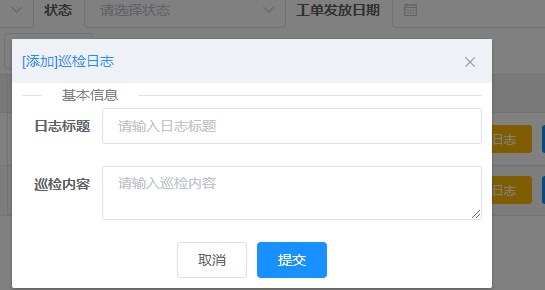
Production / Add patrol log
Add patrol log dialog: a title field and a content field, with cancel and submit buttons
Two fields only: a title and what happened. The fewer the fields, the more likely the foreman writes one a day — this is the step most often skipped, so it has to be the fastest.
WhoWho pressed itEvery action is bound to an account and a department. People leave; the record does not.
WhatWhat gets writtenTime, attachments, quantities, remarks, and a log of which fields changed.
ThenWhat you can ask laterWhere this machine stalled, for how many days, and who signed at the time — in one query.

Break It Down

Drawings break down, material gathers up

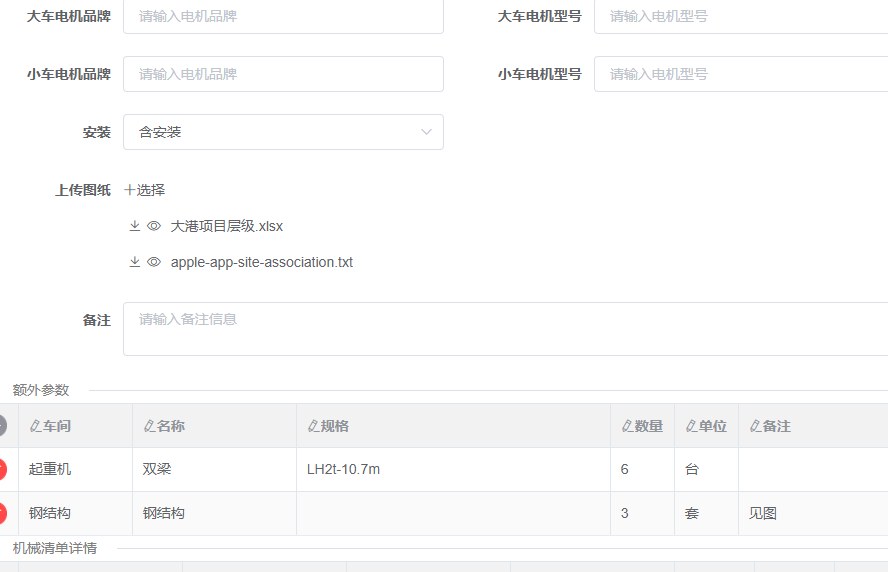
The breakdown step is the waist of the system. One machine splits into two things: extra parameters (double girder, steel structure — LH10-10.7m, six units; three steel structures) and mechanical and electrical lists (girder s=10.6m, six pieces; long-travel motors, three; transformer, one). At that granularity purchasing knows what to buy, the warehouse knows what to receive and the shop knows what to draw — if it does not break down to parts, the system is only a ledger.
  • Project LS-377 PROJECTcontract · customer · delivery
    • Order 20211009 ORDERdouble girder · 10 t · 10.7 m span
      • Extra parameters PARAMcranes 6 / steel structures 3
      • Mechanical list MECH001 girder s=10.6m ×6 · 002 long-travel motor ×3
      • Electrical list ELEC003 transformer 500V ×1
      • Drawing files FILEreleased per department, who opened it is logged
      • Patrol log LOGone entry a day until completion
    • Order 20210927 ORDERsecond unit, different parameters, no shared list
Design / Order detail · breakdown
Order detail: two drawing files uploaded, extra parameters listing a double-girder crane LH10-10.7m six units and three steel structures, mechanical list with girders and long-travel motors, electrical list with a transformer
What the breakdown looks like: extra parameters on top, mechanical and electrical lists below. Every line can be picked up directly by purchasing or the warehouse.

The risk is not breaking down too coarsely; it is that nobody accepts the result. So the list is not an attachment, it is table rows with code, unit and quantity — which become shortage requests next, and purchase orders after that. Break one link and this machine's material stays on the road forever.

The Alarm

A shortage request is not a reminder, it is a trigger

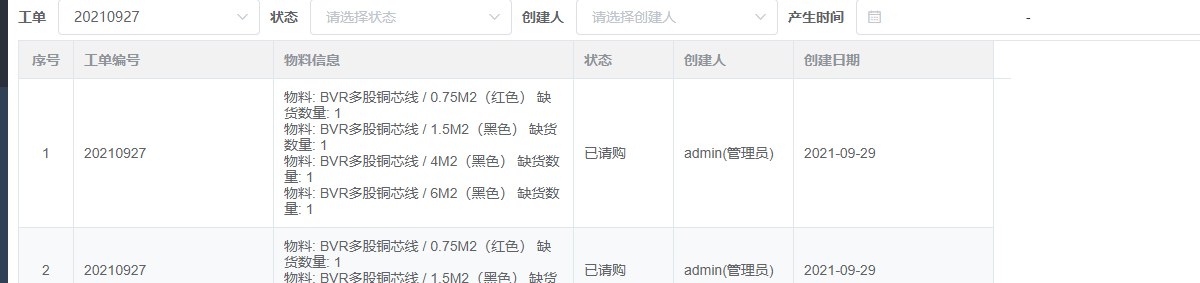
When the shop finds material missing, nobody phones and nobody posts in a group chat. They write a shortage request: what is short and how much (BVR copper wire 0.75M2 red, one roll; 1.5M2 black, one roll; 4M2 black, one roll), and the document carries the order number. Purchasing raises a purchase order straight from it, fills in supplier, price and date; when goods arrive, the receipt inherits the purchase number. Enter once, reuse three times, and the three documents point at the same machine.
01 · TRIGGERShortage requestThe shop writes what and how much. Carries the order number; this is where the chain starts.
02 · ORDERPurchase orderPurchasing adds supplier, price, date. One request can split into several orders.
03 · RECEIPTGoods receiptThe warehouse books quantity, spec and arrival date. Number inherited, not retyped.
04 · ISSUEIssue / dispatchMaterial issued or machine dispatched. Stock goes down, cost lands on this machine.
Purchasing / Shortage requests
Shortage request list: order 20210927, material lines listing BVR copper wire with specification and short quantity, status requested, creator admin, date 2021-09-29
One line per shortage, spec written so it can be ordered. A request that cannot be priced sends purchasing back to ask — and that question usually costs two days.
WriteSpecs must be orderable“Copper wire, one-five, black” becomes 1.5M2 (black), and purchasing can compare prices without calling back.
SplitOne request, several ordersDifferent suppliers, different dates, whoever arrives first is booked in first, no coupling.
TraceThe log is for next timeWho slipped, who quoted wrong — it is all on this timeline, so the next person knows the history.

Paper Relay

Three clicks on a goods receipt: print, book in, log

The step where paper gets lost is not filling it in, it is after it leaves your hand. The system makes a receipt three things: print (one copy for the supplier, one for the warehouse, same number), book in (enter the quantity, stock rises immediately), log (who changed what, when). The issue document works the same way and hangs off finished goods — one machine out, stock minus one, delivery date settled.


Stock / Goods receipt
Goods receipt list: receipt number, purchase number, supplier (blurred), material BVR copper wire, specification, unit, expected and received quantities, with print and print-preview buttons
Three keys: print, preview, book in. The number is generated and printed together with the purchase number.
Stock / Issue note
Issue note list: document cd001, work order, product crane LD14-3m, stock quantity, receipt date, issue status and a log button
Issue notes hang off finished goods: one per machine, status only issued or cancelled — no in-between state.
PaperPrinting is not archivingIt makes the sheet in the supplier's hand carry the same number as the row in the system.
StockReceipt adds quantity at onceNo approval layer: the person receiving is the person keying. One more approval, one less timely number.
LogChange it, leave a traceMistyped quantities happen; what matters is before, after and who — all three are in the log.

Eight Verbs

Stock is not a quantity, it is eight verbs

Most inventory systems have one action: plus or minus. This one gives every material row eight: log, edit, combine, split, stocktake gain, stocktake loss, scrap, issue and return. Combine and split are specific to this industry — a 500-metre rope, 180 metres used, and the remaining 320 has to go back into stock under a new code; offcuts from two jobs can be combined into one usable set.

LogEvery movement on this material, nothing deleted
EditName, spec, location — edited, then logged
CombineOffcuts into a full set, converted to the smallest unit
SplitA roll broken, re-coded, cost allocated
GainPhysical exceeds book: where, counted by whom
LossPhysical below book: where, accepted by whom
ScrapWrite-off does not go through issue, so it cannot hide in cost
Issue / returnPaired in and out; leftovers go back to the original code
Stock / Material stock
Material stock list: code 015, BVR copper wire 1.5M2 black, quantity 194, location south-east corner, actions log, edit, gain, loss, scrap, issue, return
One material, one row of buttons, exactly eight actions. A number needs a reason behind it, or the stocktake never reconciles — and nobody remembers where twenty metres went three months ago.

Stock accuracy is not decided on stocktake day. It is decided by whether people are willing to press these eight buttons during the month. So the buttons must be short, side by side, one step: gain and loss take one number, scrap takes one reason. Add a modal and you lose half the users.

Who Can See What

Permissions are not switches: three tables and one ledger

The user table says who; the role table says what they may do; the department table says how far they see. Under them sit three small things: IP restriction (intranet only), login records (who came in, when, from where) and exception logs (who changed what). Shop-floor data does not mind being read; it minds being edited on the way past — so viewing and editing are separate, and edits leave a trace.

Administration / Users
User list: account admin, department, role, status, login count, last login, and actions edit, delete, disable, reset password
One account per row, four actions: edit, delete, disable, reset password. Disable instead of delete, so signatures on old documents stay identifiable.
1
Roles decide which pages openA designer never sees purchase prices, purchasing never sees process parameters. The menu is generated per role, not left to good behaviour.
2
Departments decide which machinesThe shop sees its own orders, purchasing sees everything awaiting purchase. Data scope follows the org chart.
3
Logins and edits are keptIP restriction blocks the outside world; login records and exception logs keep the inside honest. When it matters, these two tables beat any promise.
UserThree tables: user, role, departmentDepartments first, roles second, accounts last. Reverse the order and the permissions fight each other.
AuditOne ledger: login and edit logsNobody looks at it until the day someone changes a stock quantity at midnight.
RuleOne rule: seeing is not editingApproval, write-off and quantity edits always go to different people.

Before You Start

Five questions to answer before go-live

These systems are not hard because of features; they are hard because of sequence. Same six groups, but the order you switch them on, the data you migrate and the people you start with decide whether it takes three months or a year of training.

Q1Our drawings are not digitised. System first, or scanning first?
System first, with drawings attached as files — PDF, Excel or a scan all work. Digitising drawings is a separate project; tie the two together and neither ships this year. What the system must answer is where this machine's drawing is, who opened it, which department has it, not how well it is drawn.
Q2Every machine is different. Can the fields keep up?
Split fields into two layers: fixed master fields (order number, project, contract, delivery date, status) so reports stay comparable, and floating process parameters in the extra-parameter table and the mechanical / electrical lists, entered per order. Fixed fields protect the numbers; floating fields protect flexibility, and changing a parameter never means changing the system.
Q3Purchasing or warehouse first?
Warehouse first. If stock is wrong, purchase planning is wrong. Get receipts, issues and returns flowing, and only then does a shortage request mean anything — otherwise it is just a verbal complaint with a record number.
Q4Do we migrate the old data?
Open orders yes, history no. History stays readable in Excel. Force it in and you import the old definitions, old codes and old suppliers, then explain the reconciliation every month.
Q5Six groups — how long to go live?
Run one line first: design releases drawings, production dispatches, shortages trigger purchasing, receipts and issues close the loop. Two months gets you to “people use it daily”. All six groups at once usually means three months of training. The system grows from documents, not modules — get the documents moving and the modules come alive.

MORE CASES

More Related Cases

Industrial warehouse management for a plastics compounder
EMSWarehouse management, intelligent manufacturing

Industrial warehouse management for a plastics compounder

In a plastics plant the hard question is not how much is in stock but why it changed. The same bag o...

View Details →
Production monitoring for made-to-order cranes
EMSProduction management, intelligent control

Production monitoring for made-to-order cranes

An overhead crane is a made-to-order machine: span, capacity, lift height and colour all follow the ...

View Details →
Non-standard production flow management
EMSProduction management, non-standard automation

Non-standard production flow management

On the same job, sales signs in square metres, purchasing buys in tonnes, the shop floor moves piece...

View Details →

View All Cases →

Planning a similar production line or enterprise system?

Start with our pricing logic, then let's talk requirements — cost structure, technology comparison and acceptance criteria, all laid out in the open.