


One city, one annual report

A municipal environment-technology company with seven pages: home, about, news, a news detail page, projects, culture, contact. No product page, no price page, no checkout. Its readers are not customers — they are residents asking whether the river at the end of their street has changed, owners and regulators checking delivery and compliance, and bid reviewers and suppliers checking certificates and backlog. All three are verifying, not being persuaded. So the site does not look like a marketing site. It looks like an annual report, hung on the web. This page is about how that report is laid out. Presented anonymised: company name, address, phone and email are withheld.

Industry
Municipal environment technology · water treatment / municipal roads / ecological repair
Site type
Corporate site, 7 pages · six top-level sections plus one detail page · no product or price page
Deliverables
Information architecture · section system · project index (water / road / city lines) · organisation and certificate presentation · front-end build
Jiding role
Information architecture, interface design, front-end build, image work and anonymisation
7 pagesSix top-level sections plus one detail page; each page argues one thing
3 linesWater, road, city — projects filed by the geometry of the infrastructure
46 projectsIn progress and delivered, every one hung on a stop along a line
14 certificatesListed as a register: issuer, number and expiry date, not as trophies
  1. 01Not a marketing siteThree readers, three first screens
  2. 02Contents and numbersThe skeleton of a report
  3. 03Three linesWater / road / city
  4. 04One roadChainage and gradient
  5. 05One plantSix stages of water
  6. 06Who does itOrganisation tree
  7. 07Why trust itCertificate register
  8. 08How news is setA broadsheet front page
  9. 09Culture and party workA red-header notice board
  10. 10Hiring and contactJob spec and formal letter

Annual report · 2026

One city,
one report

The first screen used to be an aerial photograph of a building with a slogan across it. We replaced it with a cover: on the left, the six things this company has to account for this year; on the right, one upright photograph. A report does not need to shout on its cover. It needs to make it obvious that there are six chapters and they can be turned.

Founded
2018
Chapters
06ch.
Certificates
14on file
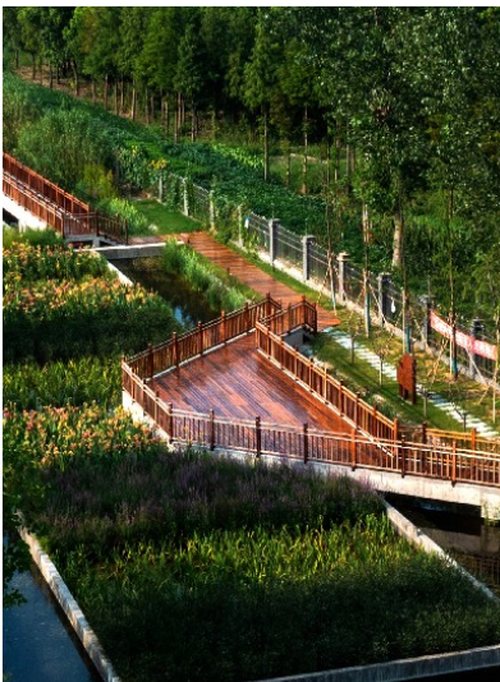
Boardwalk through a wetland park, red railings crossing ponds and reed beds FIG. 01 · Wetland section

Three readers

One report, three people turning to different pages

The most common mistake on a municipal site is treating three audiences as one. A resident wants to know whether the stretch at the end of their street has changed. An owner or regulator wants to know when the package finishes and whether the acceptance file is complete. A bid reviewer or supplier wants to know whether you hold the certificate, how much is in progress, and who runs technical quality. Three questions, three layouts. Crammed into one first screen, none of the three finds its entrance.

Citizen

Residents

Not the process — the place. The first screen has to be a project photograph plus one sentence saying what this stretch became, findable by street or by river reach.

One thing only: when is the stretch by my door finished

Owner & regulator

Owners and regulators

Schedule, acceptance, variations. The first screen gives a list of work in progress, key milestones and the responsible person, and drills into a delivery ledger per package.

One thing only: do the schedule and the file agree

Bid reviewer & supplier

Reviewers and suppliers

Certificates, track record, structure. The first screen gives the register, the project index and the department split — three things that get checked against a number.

One thing only: does your certificate number match the bid file

Three first screens are not three home pages. They are three entrance blocks on the same home page, ordered by traffic: residents first, owners second, reviewers last but least tolerant of error. The reviewer block is the quietest — no motion, no carousel — because it may get printed and checked line by line.

Contents

Contents first, pages after

A report is readable because it tells you up front how many chapters there are and what each covers. The site treats its six top-level sections as six chapters: number, name, one line of description. No scrolling to find out what is here. Below is what the company has to account for this year — bar height carries the order of magnitude, the figure sits on top of each bar, like a skyline seen from the far bank.

2018foundedSTART
3linesWATER · ROAD · CITY
46projectsLIVE & DELIVERED
7departmentsFUNCTIONS
14certificatesON THE REGISTER
City skyline: low-rise housing on the left, glass towers in the middle, a gate-shaped supertall on the right
The site never says "we are professional". It gives six numbers that can be checked.FIG. 02 · Skyline

Numbers have to hold. Each of the four links onward: 2018 to the timeline in About, 3 to the three lines, 46 to the project index, 14 to the register. In a report a number is not decoration. It is an index entry.

Three lines

Not a card waterfall — three lines

These projects share one property: they sit on the ground, and they connect. A road is linear, from one chainage to the next. A treatment plant is a node, raw water in one end and clear water out the other. A district is an area, fenced and bounded. Sorted as a waterfall, nine projects look identical. Sorted into three lines, a reader remembers that this company runs a water line in the east of the city and a road line around it.

WaterLine 013 plants · 1 river reach
East plant150,000 m³/day
South reuse plant50,000 m³/day
River reach8.6 km
West pump stations4 units
RoadLine 022 arterials · 1 interchange
North ring extension8.6 km · 6 lanes
East avenue rebuild4.2 km
New port interchange3 levels
Cycle network12.4 km
CityLine 032 districts · 1 park
High-speed rail district6.2 km²
Old town renewal3 blocks
Riverside park46 ha
Utility tunnel5.8 km

The three lines differ in stroke, colour and stop: water is a solid blue rule, road a doubled grey pair, city a dashed green. A reader does not need the copy to know which class they are in. Classification is not a tag. It is a shape.

Chainage

A road is told in chainage

A road is measured in kilometres, not in pages. So the road is not a paragraph. It is a section with chainage marks: K0+000 starts at a level crossing with the provincial road, K1+400 crosses the river, K3+200 carries the interchange, K5+000 enters the tunnel, K8+600 ties into the far bank. The rise and fall of the asphalt band is the longitudinal gradient; the line beneath says what happens at each mark. A reader checks which section of this contract their junction falls in.

K0+000
K1+400
K3+200
K5+000
K8+600
StartK0+000Level crossing with the provincial road, six lanes
River crossingK1+40086 m main span, continuous beam
InterchangeK3+200Three levels; the critical structure of this contract
TunnelK5+000Twin bores, four lanes, 720 m
EndK8+600Ties into the far-bank approach, full run open
K0K2K4K6K8+600
Aerial view of a road cutting through dense forest, the asphalt curving to the lower right
A road needs three things on a website: chainage, nodes, status.FIG. 03 · North ring

Chainage is the only coordinate this road has. Programme, variations, acceptance, resident complaints — all of them hang on a chainage. Putting chainage on the page puts the project coordinate system on the page. When the owner says "the interchange at K3+200", nobody has to ask which stretch that is.

Section

A plant told in six stages of water

The treatment process is a vertical line from turbid to clear: inlet, screen, biology, clarification, filtration, disinfection. Most sites draw five icons and some arrows. It looks like a flow chart and says nothing. This version is a water column: each block is the colour of the water in that tank, and the figures on the right are retention time and removal rate. The colour walks from ochre to pale blue. A reader can see, without reading, where the water turns clear.

InletRaw
0 minSS 180 mg/L
ScreenGrid
12 minGross solids out
BiologyAeration
6.5 hCOD −88%
ClarifySettle
2.1 hSS to 12
FilterMedia
38 minSS to 3
DisinfectUV
30 minMeets standard
Total retention · surface water class IV≈ 9.8 hours
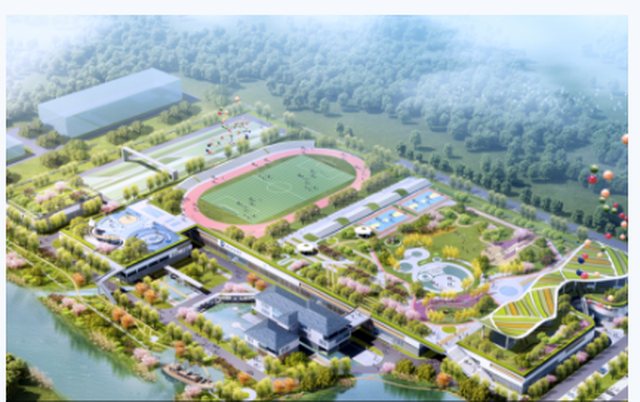
Aerial view of a treatment plant: tanks buried under a soil cover carrying a running track and park, water on three sides
Semi-underground: tanks below, a sports field on the roofThe east plant occupies 10.69 hectares. The tanks sit underground under a two-level cover, and the roof goes back to the public as a running track and a park. One sentence on the website, and it persuades better than ten renderings.FIG. 04 · East plant
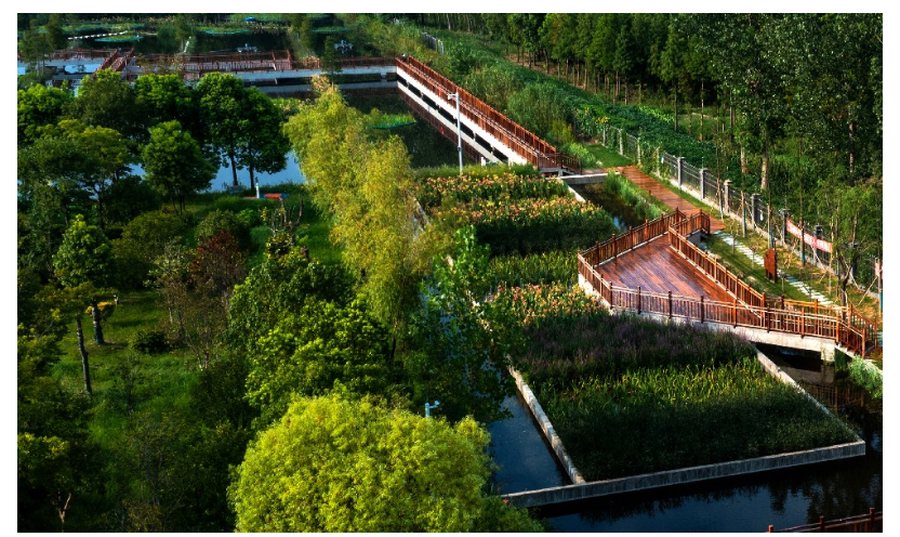
Wetland park seen from above: boardwalks crossing aquatic planting, treatment structures to the right
Effluent is not discharged — it walks through a wetland firstFinal effluent passes a constructed wetland for polishing before reaching the river, and the wetland is open to the public. The site gives this its own page, because clear water is something residents have to be able to see.FIG. 05 · Polishing wetland

Organisation

Draw who is accountable

The site has to carry an organisation chart, for practical reasons: it goes into bid documents, suppliers need a name to call, residents need to know which department handles a complaint. Not a pretty circular diagram — a tree. Governance at the top, functions at the bottom, one vertical rule running down. A tree makes the levels obvious: anyone can see who reports to whom.

  • Shareholders' meeting
    • Board of directors
      • Chairman
        • General managerManagement
          • General affairs
          • Finance & planning
          • Engineering
          • Technical quality
          • Safety & environment
          • Operations
          • Party & union
    • Supervisory boardIndependent of management

Two of the seven departments are specific to this kind of company: technical quality owns the acceptance standard, and safety & environment owns discharge and site safety. Both need their own entrance on the site, because they are exactly what an outside checker comes looking for.

Register

Certificates as a register, not a trophy wall

An honour wall is for visitors. A certificate register is for people checking numbers. A reviewer opens the bid file and the first thing they check is the certificate number; a supplier looking for a specific qualification searches by name. So the fourteen certificates are set as one table: index, certificate, issuer, number, expiry — one per row, figures in a monospaced face. Anything added in the last three years carries a red mark at the end of the row.

No.CertificateIssuerNumberExpires
01Municipal public works, general contractor (Class I)Provincial housing authorityD1320000xx2028-06-30
02Environmental engineering, specialist contractor (Class II)Provincial housing authorityD2320000xx2027-11-15
03Pollution control facility operation (domestic wastewater)Provincial environment authorityJX-WS-20xx-xx2027-03-31
04ISO 9001 quality managementAccredited body00120Q30xxx2027-08-20
05ISO 14001 environmental managementAccredited body00120E30xxx2027-08-20
06ISO 45001 occupational health & safetyAccredited body00120S30xxx2027-08-20
07Municipal design, drainage engineeringProvincial housing authorityA2320000xx2029-01-10
08Water conservancy works, general contractor (Class III)Provincial housing authorityD3320000xx2028-09-05
09Work safety licenceProvincial housing authority(S)JZ-xxxx2027-05-18
10Urban drainage permit (operation)Municipal water bureauPS-20xx-0xx2026-12-31
11High-tech enterpriseProvincial science & technology departmentGR20xx32xxxx2027-12-08NEW
12Provincial enterprise technology centreProvincial industry departmentJS-TC-20xx-xx2028-04-22NEW
13Sponge-city applicable technology (registered)Municipal housing bureauHM-20xx-1xx2027-07-01NEW
14Water safety standardisation (Class II)Provincial water resources departmentSL-AQ-20xx-xx2028-02-14
14 in total · 3 added in the last three yearsNumber tails anonymised

A table is harder to build than a card, and worth it. A card proves "we have it". A table proves "we have it and it survives checking". The masked digits keep their format, because the format is information too — a reviewer can tell which numbering scheme a certificate belongs to.

Broadsheet

News set as a broadsheet, not cards

Nobody searches this news. People leaf through it, and leafing means scanning headlines. So the layout is a front page: one lead story taking most of the width, a three-step headline, four briefs down the right, one full-width strip along the bottom. Three seconds tells a reader what happened this month. A single column of equal-weight titles cannot do that, because every item weighs the same.

CITY ENVIRONMENT · MONTHLYNovember 2026 · No. 87
Wetland park and treatment structures from above, boardwalks crossing aquatic planting

East plant wetland opens: 50,000 tonnes of water a day, and it walks through the trees first

The 46-hectare wetland polishes final effluent through three stages of planting before it reaches the river; key indicators meet surface water class IV. A 3.2 km waterfront walk opens at the same time.

The effluent wetland at the east plant opened to the public this month. "Effluent" is the water that has already been through the plant and would otherwise go straight to the river. The wetland exists so that this water walks through trees and reed beds before it gets there.

The wetland is graded in three stages along the flow: emergent planting first, cutting nitrogen and phosphorus; submerged planting second, pulling down suspended solids; deep water last, for stability and storage. The whole run is gravity-fed, with no lift pumps.

The waterfront walk runs 3.2 km and links three viewing decks. Plant and wetland are physically connected; from the walk you can see the outside of the treatment structures, but the tanks are underground and not open to visitors.


BRIEF

Twelve projects in progress this month; two started, one accepted. Zero safety incidents, 1,284 days and counting.

Note the headline steps down across three lines: the first says the conclusion, the second the scope, the third the effect. A newspaper gets its hierarchy from type size, not from divider rules. The four briefs carry only a number, a title and a date, because their job is to say "these also happened".

Culture & party

Culture is not decoration here — it is a compliance section

A commercial company can fill its culture page with values and photographs. This kind of company cannot. Its culture page has to carry party-building and union work, and it has to be current. That is not an aesthetic choice; it is an organisational fact — party-building leads union work, union work leads activities, activities lead the public face. So the page is set as a red-header notice board: three recent items on the left, one line of purpose on the right, the year as a signature.

Party & union work2026

"Honour mothers, share books" — the second reading session of the staff library, held at the east plant, 32 employees attending.

Volunteer service at the water open day: staff explain the three-stage wetland process to visitors.

"Safety around us" team competition closes; operations team two takes the quarterly award.

For this city,
we work on urban development,
on raising urban value,
on making it liveable.

— Culture page, opening note

There is one rule for these items: who, where, how many, what they did. Never "thoroughly implement" or "comprehensively improve". The first is a record; the second is a posture. These pages get read more often than you would think — by a supervisor inspecting, or a peer benchmarking.

Hiring & contact

Hiring as a job spec, contact as a formal letter

Job ads usually pile duties into one paragraph, and the applicant still cannot say what they would do all day. Here each role splits into two facing columns: duties on the left (what you do daily), requirements on the right (what qualifies you). Contact is not a form either. It is a formal letter, because the person writing in is usually sending an official request that needs a heading and a signature to copy.

Energy & soil-conservation engineerTechnical quality · 2 seats · full timeDegree · 3 yrs
Duties
  • Prepare energy assessments and soil-conservation plans; support approvals
  • Join drawing reviews; check that measures can actually be built
  • Track implementation on live projects; keep monthly inspection records
  • Support completion acceptance; assemble the specialist file
Requirements
  • Soil conservation, environmental or municipal engineering
  • Familiar with assessment and plan-preparation standards
  • Able to write a report end to end; approval experience welcome
  • Comfortable on site; clear written Chinese
Consulting project managerEngineering · 1 seat · full timeDegree · 5 yrs
Duties
  • Own schedule, quality and cost across consulting engagements
  • Liaise with owners and regulators; organise deliverable reviews
  • Issue weekly and monthly reports; drive issues to closure
Requirements
  • Engineering management or civil engineering
  • Class-I constructor or consulting engineer preferred
  • Strong coordination and documentation skills
Tendering & contract administratorFinance & planning · 1 seat · full timeDegree · 3 yrs
Duties
  • Assemble bid documents; own prequalification and commercial volumes
  • Keep the contract register; track delivery and settlement milestones
  • Watch certificate expiry and renew ahead of time
Requirements
  • Engineering or economics; familiar with tender law
  • Municipal bid experience preferred
  • Careful, and calm under bid deadlines
To apply: send a CV to the recruitment inbox (anonymised on this page) · subject line "role + name"Open until filled
To:Partner organisations, suppliers and residents
Entity
Municipal City-Investment Environment Technology Co., Ltd.(anonymised)
Address
No. 1 Kechuang Avenue, High-tech District · Floor 12, Environment Towerpostcode 2xxxxx
Switchboard
0xxx-8888 xxxxweekdays 9:00–17:30
Fax
0xxx-8888 xxxx
Email
contact@example.comcopy the tender office for commercial matters
Visits
Book one working day ahead; register at reception with a letterplant areas are closed to visitors
Municipal City-Investment Environment Technology Co., Ltd. November 2026
Company
seal

FAQ

Four questions we get about sites like this

Why lay out a municipal or state-owned site as a report rather than a marketing page?

Because nobody arrives to buy. Residents want to know whether the river has changed; owners and regulators want to verify delivery and compliance; reviewers and suppliers want certificates, backlog and structure. All three are checking, not being persuaded. So the page has to offer things that can be checked: contents, numbers, dates, numbers on certificates, named owners.

With only a handful of projects, how do you fill a projects section?

Do not use a card waterfall; use the geometry of the infrastructure. Roads are linear, so sort by chainage. Plants are nodes, so sort by process. Districts are areas, so sort by boundary. Nine projects as nine identical cards and nobody remembers one; nine projects as three lines and a reader remembers that this company runs a water line in the east of the city.

Do the organisation chart and certificates really belong on a public site?

For this kind of company, yes. Bid documents already require the chart and the certificates; the site simply publishes them early, so a reviewer makes one phone call fewer and a supplier knows which department to approach. Certificates should be a register — index, name, issuer, number, expiry. Six decorative certificate cards are useless, because nobody checks a number on a card.

Can this structure be reused for another state-owned or city-investment client?

Yes, as long as the core business is building and operating city assets. The three lines can become supply–drainage–river, bus–rail–hub, or park–plant–services. Chainage can become pipeline chainage, tunnel bay or station sequence; the water column can become any process with an order. What you keep is not the layout but the question: who will come to check what, and what do they need in front of them.

MORE CASES

More Related Cases

Brand official website · Smart electric vehicle
Brand WebsiteSmart manufacturing, smart cars

Brand official website · Smart electric vehicle

The client is a smart EV company listed on an overseas exchange, headquartered in the Middle East, w...

View Details →
Brand website · one enquiry, one sheet
Brand WebsiteIndustrial Automation

Brand website · one enquiry, one sheet

A website for an authorised industrial-automation distributor: eight product categories of drives, s...

View Details →
Brand website · one line, one website
Brand WebsiteNon-standard automation

Brand website · one line, one website

An automotive-electronics equipment builder runs a six-section corporate site: About, Products &...

View Details →

View All Cases →

Planning a similar production line or enterprise system?

Start with our pricing logic, then let's talk requirements — cost structure, technology comparison and acceptance criteria, all laid out in the open.