
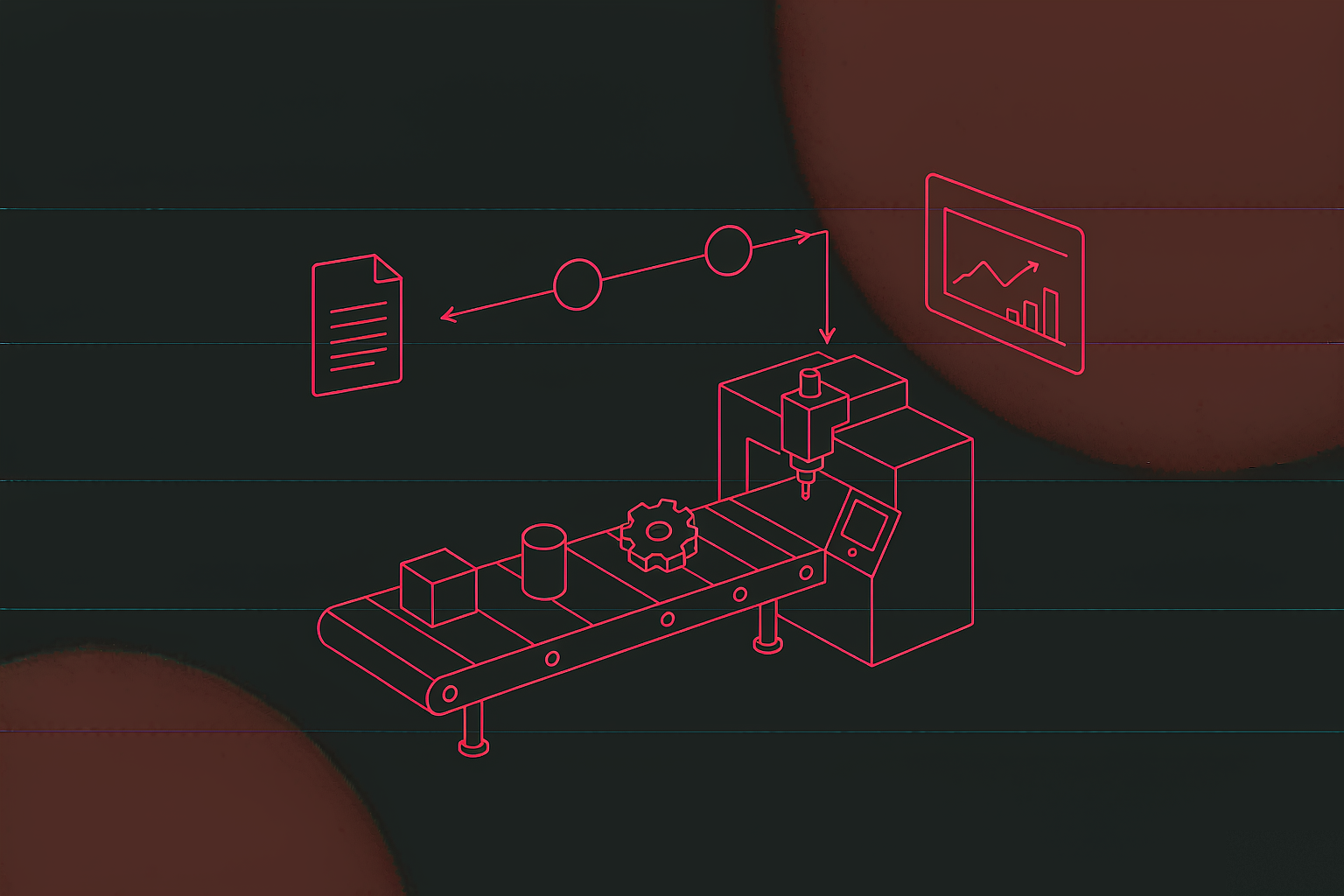
Non-standard production flow management
On the same job, sales signs in square metres, purchasing buys in tonnes, the shop floor moves piece...
View Details →Four Ledgers
“Non-standard” does not mean no standards. It means every order is planned again: a different panel thickness, a different hole pattern, a different delivery address, a different truck. So one batch carries four names, four units and four update moments. Each number is right on its own; together they are unusable.
A typical morning: sales says the job is contracted for 49,457 m²; the warehouse says only 7.5 tonnes of that panel are left; the shop floor says machine No.3 is still running last month's truck; finance says the invoice is issued but the goods have not shipped. Nobody is wrong, and nobody can answer “how much is still outstanding on this job”. The system does not need people to work harder — it needs those four sentences to become five numbers on one row.
System Map
The menu is split by department into eight chapters, which makes it look like eight systems. Structurally there are only three layers: the project spine in the middle (customer → project → BOM → plan → stock → settlement), the material foundation beneath it (raw material, machined parts, accessories, warehouse, requisition, stock statistics), and four closing loops on the right: purchasing, sales, production and finance. Reports create no data; they re-slice five quantities along a different axis.
The six rows below are the real pagination bars from the manual's demo environment. They are not here to show off volume, but to make one point: this system is sized for a few hundred transactions a day, not for one Excel import a month.
The Spine
A project passes through seven gates between signing and settlement. In custom production, most failures can be traced to a gate that never reached a table: the customer only exists in WeChat, the recipe only in a senior engineer's head, the plan only in Excel, the material issue only on a slip of paper. All the system can do is turn every gate into a timestamped record.
Of these seven gates, only the fifth is “the shop floor making something”. The other six are records. That is why the system's weight sits in fields, validations and audit trails rather than in dashboards — one missing field and the gate leaks.
Project
Everything in custom production hangs off the project: material demand, recipes, plans, stock, shipments, invoices. So the project list screen is dense — it is really the company-wide project dashboard. One look here tells you more than ten reports about which job is about to go wrong.
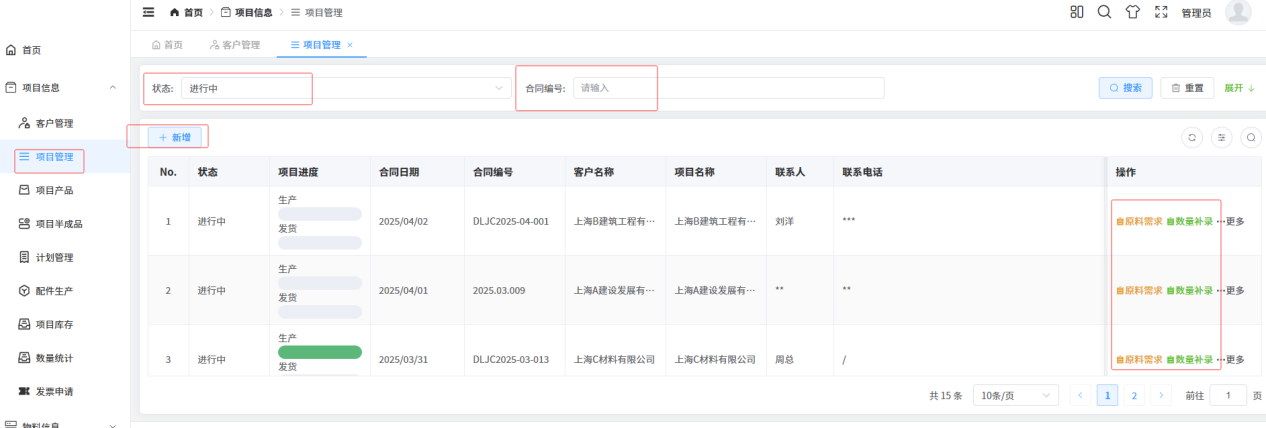
Why “quantity backfill” deserves to be a first-class feature rather than a patch: on a custom line the panel is often already cut and drilled before the plan reaches the system. The system cannot assume plan-then-produce; it can only guarantee that the backfilled row shows when and by whom it was added. Get that right and every report downstream becomes credible.
Two-Tier BOM
A project finally delivers a product (a panel type, measured in m²), but the floor first makes a semi-finished panel (routed, not yet drilled or dispensed). The recipes differ: the product recipe decides how much semi-finished stock and how many accessories the job consumes; the semi-finished recipe decides how much raw panel to cut. Merge them into one tier and material issue either double-deducts or misses.
Those four tables form the material foundation that every issue, stock figure and cost draws from. One duplicated material name and every report drifts — which is why we spent two full days cleaning master data before go-live, merging “panel 2.1”, “panel 2.1mm” and “panel-2.1” into one record.
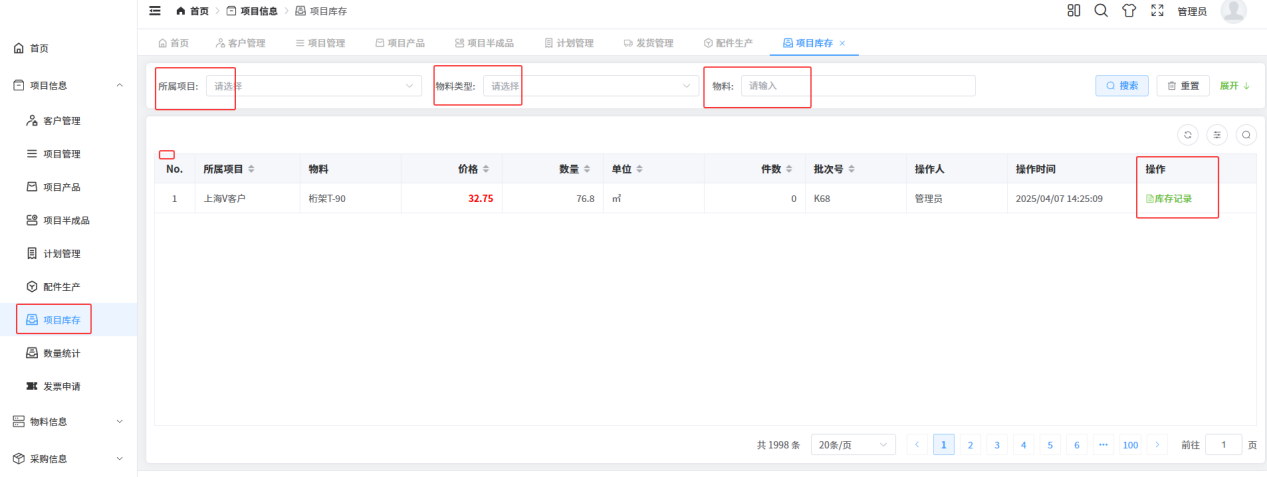
One design decision is easy to miss: project stock and warehouse stock are two ledgers. Warehouse stock answers “how much material does the company hold”; project stock answers “how much has this job already claimed”. Material issue is the only bridge — without an issue document the material is still in the warehouse, and the job has no cost.
Planning
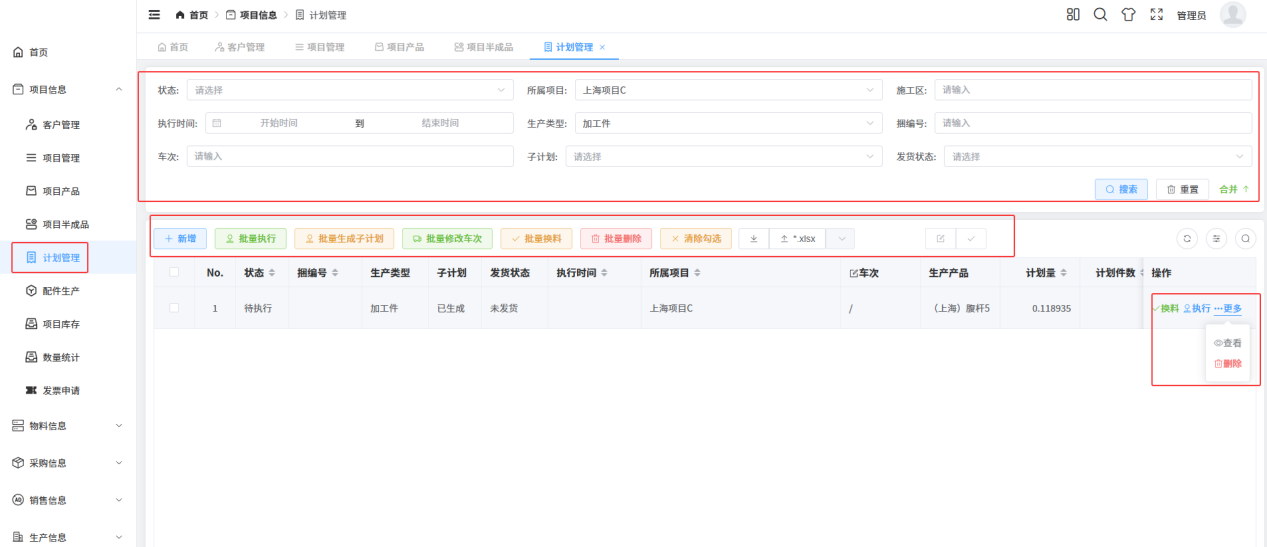
Custom planning has three traits: many rows, frequent change, and truck-load grouping. So the point of this screen is not “add a row” — it is the row of bulk buttons and the nine filters. A factory that re-plans three times a day cannot survive on single-row clicks.
Material Chain
Demand starts as a requisition, purchasing turns it into a purchase order, the goods are weighed in as a receipt, and the machining plan issues from warehouse stock. The four are separate for a plain reason: the person who asks does not spend, the person who spends does not hold stock, the person who holds stock does not keep the books. One document needing three signatures ends up with nobody accountable.
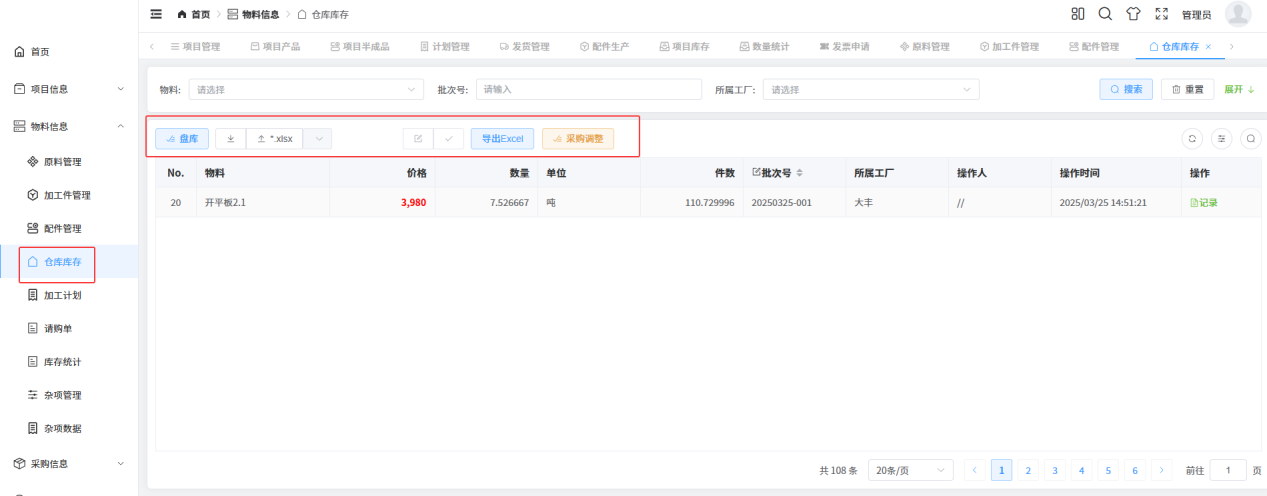
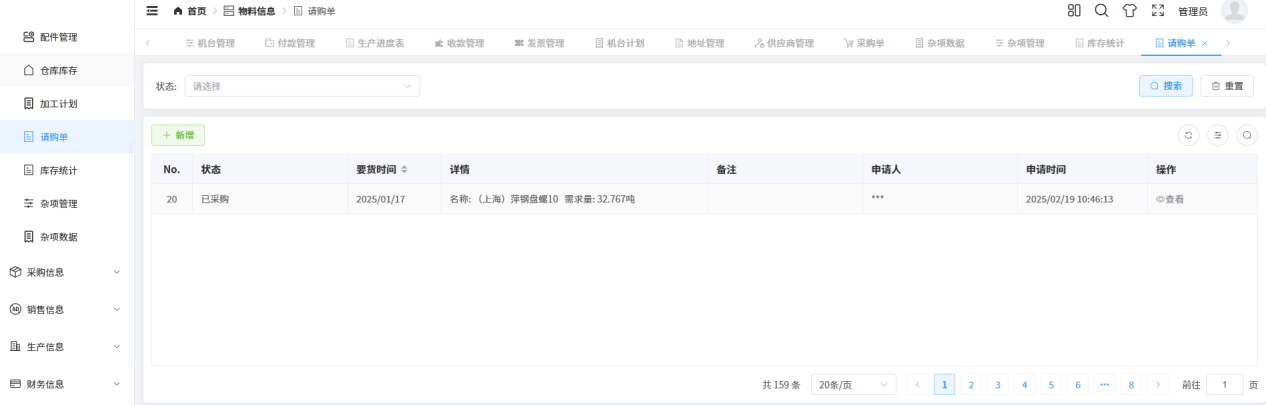
A stocktake does not change a number; it records a difference: counted, booked, delta, and who counted. The same holds for purchase adjustment — a wrong price must be fixable, but the fix must leave a trace, otherwise next month's cost report has no defence.
Units & Reconciliation
One batch changes unit three times: purchased by tonne, received by piece, delivered by m². Get a conversion wrong and the books never reconcile. The approach is dull but effective: each step recognises only its own unit, conversion happens at the moment of the action, and the conversion basis (pieces, unit price, area) is stored with it.
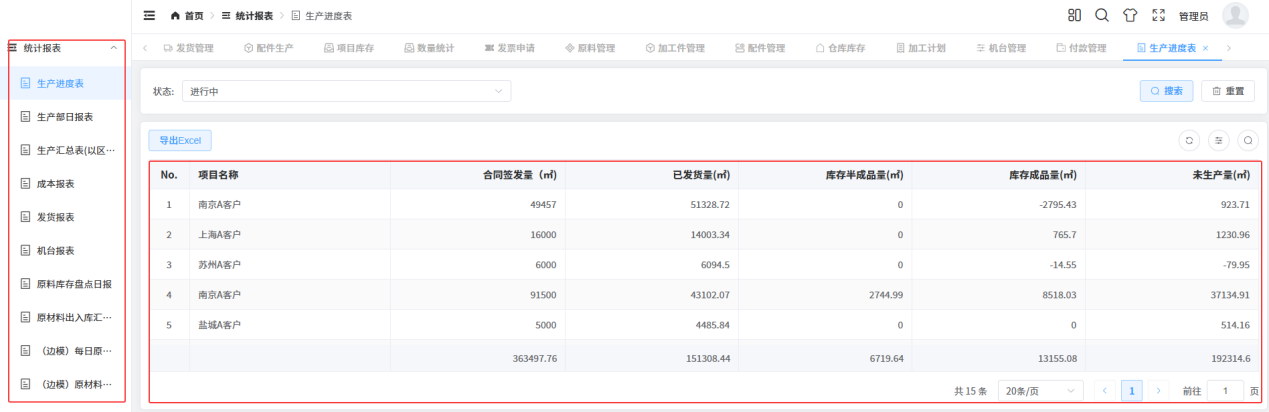
The production progress report is the most ledger-like table in the system: one row per project, five measures across, totals at the bottom. Its value is not looks but that any row, and the total row, satisfies the same identity.
All three hold, including the negative stock. Figures from the manual's demo environment; totals and rows are both in m².
A negative number is not an arithmetic error; it means more was shipped than the warehouse held. Either an over-shipment, or last batch's finished goods were never booked in. On a report, a negative is a red flag for the planner, not a mistake for the accountant. Only a report whose negatives can be read is a report worth meeting over.
Machines
Drilling, routing and dispensing are different machines with different cycle times, yields and changeover costs. A plan therefore has to land on a machine: how much this machine is scheduled for this month, how much this shift produced today. Land it on a machine and you can schedule; land it on a workshop and you are guessing.
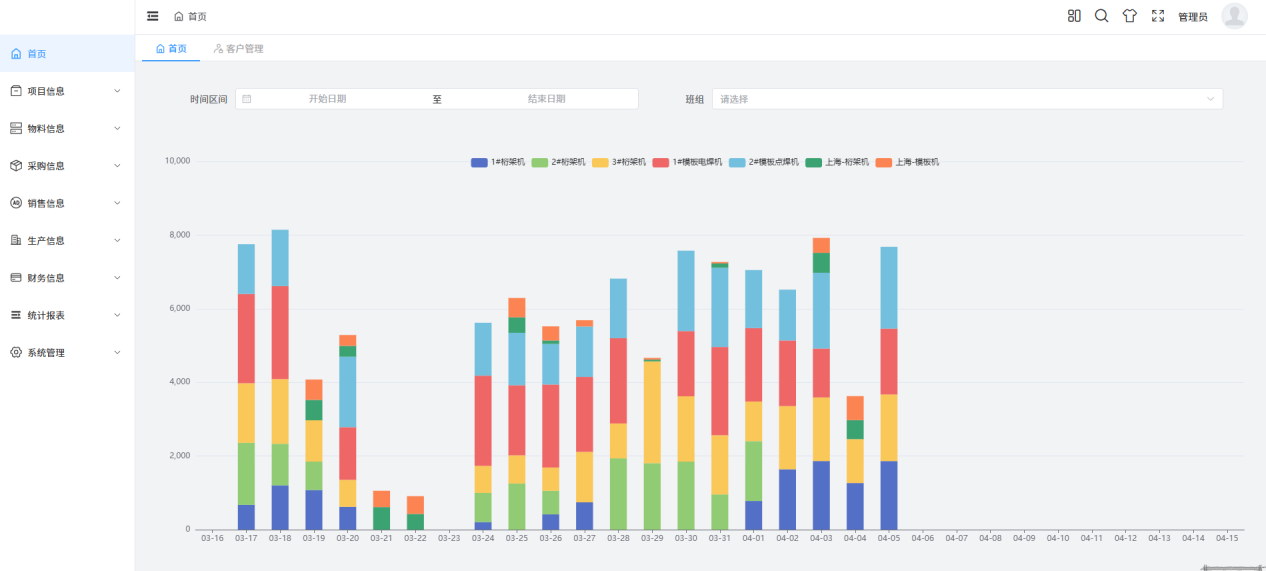
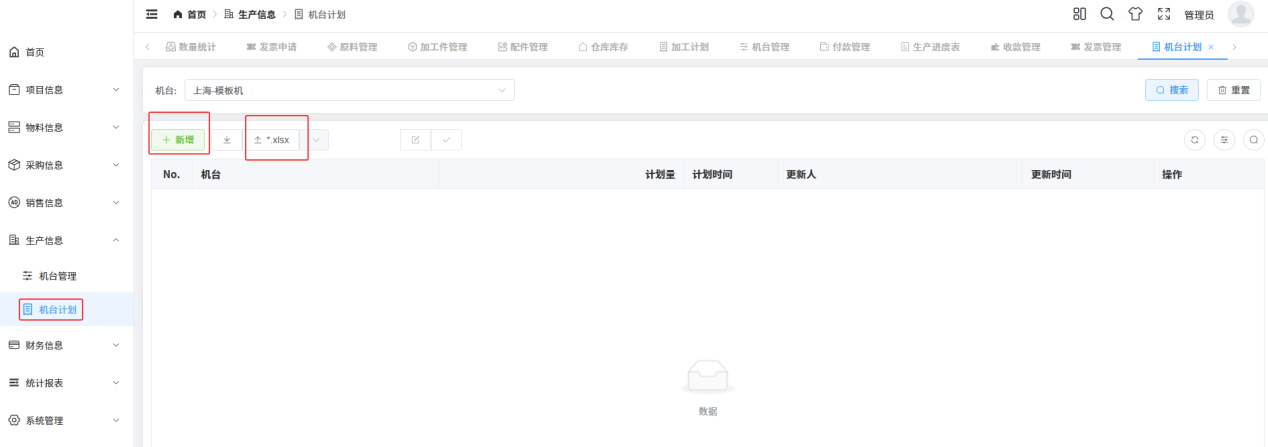
The machine dimension has a hidden job: it cross-checks the project report. If a project claims production is finished and the machine report cannot find the output, the report was probably booked against the wrong project — an error that is invisible in the project view and obvious in the machine view.
Roles
The hard part is not the number of features; it is letting each person see only what they need and change only what they own. This table was agreed with the client during go-live: what each role looks at first every morning, where it lives, and which column they may edit.
| Role | First look every morning | Where it lives | May only change |
|---|---|---|---|
| Sales | the two progress bars (production, shipping), due dates | Projects, shipping | contract data, shipping notes, addresses |
| Planner | pending plans, truck completeness, unproduced area | Planning, machining plan, machine schedule | planned quantity, truck, sub-plan split |
| Warehouse | pending receipts, stock differences, requisitions | Warehouse stock, requisitions, purchase orders | received quantity, stocktake delta, purchase adjustment |
| Shop floor | today's planned quantity on this machine | Machine schedule, machining plan | reported output, material issue |
| Finance | shipped not invoiced, invoiced not received | Invoices, receivables / payables | issue, void, record receipt, offset advances |
Permission is not “can you open this menu” but “can you change this column”. On the same project, sales may edit the contract number and the planner may not; the planner may move a truck and the warehouse may not; the warehouse may adjust a stocktake delta and finance may not. Column-level rights are more work than menu-level rights, and they prevent ninety percent of the arguments.
Delivery & FAQ
Production systems rarely fail for lack of features; they fail because three months later everyone is back in Excel. These five questions come up at every custom factory, from the plant manager and from IT.
MORE CASES
On the same job, sales signs in square metres, purchasing buys in tonnes, the shop floor moves piece...
View Details →
A supplier delivery management system: prices customised per customer group, with different customer...
View Details →
A supply-chain service provider for cross-border apparel sellers: shops live on Amazon and other ove...
View Details →Start with our pricing logic, then let's talk requirements — cost structure, technology comparison and acceptance criteria, all laid out in the open.