
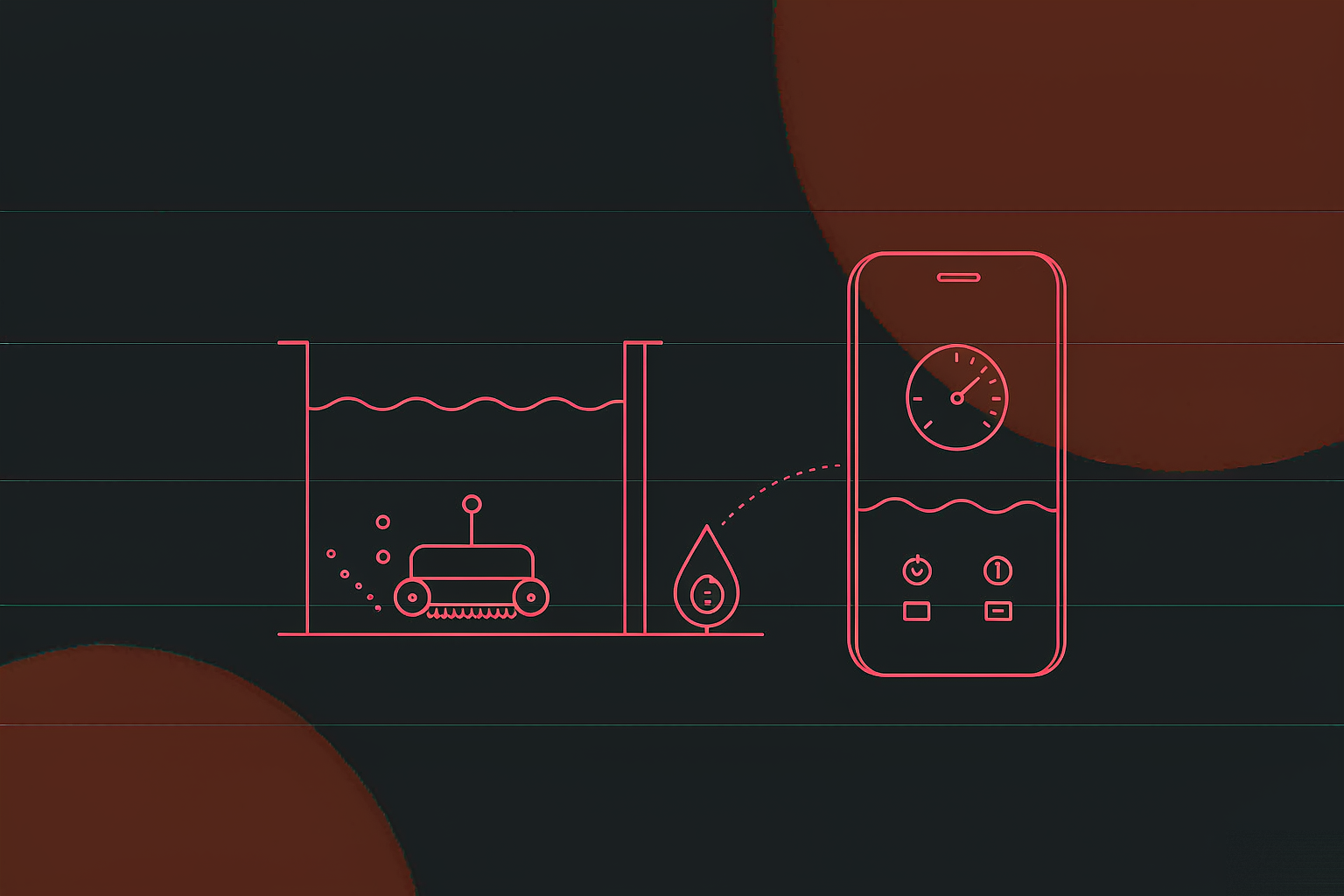
Pool-cleaning robot companion software system
Companion software for a pool-cleaning robot: a PC back office plus Android / iOS apps; devices come...
View Details →System Architecture
The back office, the dual apps and the hardware in the pool share one TLS-encrypted MQTT message bus — commands out, status back, maps and log files, all on the same trail.
Connection Chain
The robot ships with no network config, so the first kick is the app's Bluetooth — provision, pick a region, swap the key, shake hands, bind; only then is the device truly on the cloud.
▲ Six app modules: Android and iOS identical; email verification code handles sign-up and sign-in; a privacy policy ships for overseas markets.
The app shakes hands over Bluetooth and writes the home Wi-Fi into the device — its first time online.
The chosen region returns its own MQTT address, so the device lands on the nearest entry.
The device's fixed SN number requests a TLS key — one key per machine.
Certificate stored, the hardware completes the MQTT handshake in TLS mode and the link is sealed.
The device activates online and binds to the user's account; the office sees who owns what.
Mapping, control and OTA all ride this encrypted line, every message queued and logged.
Mapping & Tracks
Position messages stream up the cloud MQTT link and the app renders the pool map with the cleaning track; users can even draw a no-go zone and the robot obeys — the map is not just for looking, it gives orders.
Device Control
The app's device module splits daily use into four entries — see the status, reach the controls, tune the parameters, check the history.
Work progress, battery and messages in real time — how far the robot has got and how much charge is left, known from the app without peering over the pool edge.
Start-stop and mode switching go out through the app and ride the MQTT link straight to the device — the pool side is optional.
Adjustable run-time settings live in the app; cleaning strategies for different pools and seasons change on the spot, no re-provisioning needed.
Completion, cleaning track, time and energy spent are all reviewable afterwards — how long the run took and what it cost stays in the account.
Back Office
The back office organises into user, device and system management — from sign-up to retirement, every stage has a record.
Core Services
The platform lifts shared capabilities into services — auth, activation, file, cache, scheduler plus the MQTT trio — so business modules can mind their own business.
Deployment & Delivery
The project runs on dedicated servers — app, database, MQTT and file each on its own box; data safety and platform stability are architectural from day one.
Operating manual and user guide ship with the system, videos included.
Pre-launch talks, post-launch training and in-life feedback, all free of charge.
Testing, debugging and optimisation before deployment; nothing ships half-done.
Formal go-live with the system and its documentation handed over.
Uptime care, code upgrades, database backups, server management and support guides.
Project-specific servers; data safety and stability have an owner.
FAQ
Three ways. The connection starts at Bluetooth — the device ships without network config and only comes online after app provisioning. Communication is encrypted end to end — the regional MQTT address goes out by region, and the fixed SN number fetches a TLS key before the handshake. And the interaction is heavy — pool mapping, track rendering and zone editing are graphical operations whose canvas-touch input travels back to the office and out to the device, not an on-off switch.
While the robot works, position messages stream up the cloud MQTT link; the app renders the pool map and the cleaning track from them, with progress, time and energy at a glance. The user can also edit zones on the map with canvas touches (a no-go area, say) — the drawing goes to the back office first, then syncs to the device. The map is not just for looking; it gives orders.
Four lines of defence: Bluetooth provisioning brings the device online; the regional MQTT address plus a TLS key fetched against the fixed SN number encrypt the link; the auth service issues standard JWT tickets for global identity, and services like file storage honour them; the office records every sign-in with time and IP, every request in the access log, and every system exception — nothing goes unanswered.
Upgrades ride OTA: the back office sets version-match rules and uploads the package, and devices update online — no factory return. Multilingual works on two fronts: the app interface supports several languages with a built-in privacy policy, and the back office carries its own language configuration; both grow with the market.
Deliverables & Results
The most direct change is on connection: from bare-metal out of the box to encrypted duty, the six-step chain guides every device — one TLS line per machine, no eavesdropping on commands, no hijacked firmware.
The second change is on experience: the pool map and cleaning track render live in the app, zones are drawn with a fingertip and the robot complies; progress, time and energy stay reviewable, giving the product word-of-mouth backed by data.
The third change is on support: MQTT commands and results are all on record and run logs download freely, so overseas support checks instead of guesses; OTA iterates export units without a factory return. The project ran with two back-end and two app developers, four months of development plus four weeks of testing; as agreed, this page names no client and carries no pricing or effort figures.
Building companion software for a pool robot or another cleaning appliance? Settle three questions first: how the Bluetooth provisioning and activation chain is designed, how the MQTT messages are architected, and how map rendering and zone editing should feel.
MORE CASES
Companion software for a pool-cleaning robot: a PC back office plus Android / iOS apps; devices come...
View Details →
A shopping app for a health-retail brand: self-operated quality assurance, curated and daily-plus zo...
View Details →Start with our pricing logic, then let's talk requirements — cost structure, technology comparison and acceptance criteria, all laid out in the open.